
Building a Permanent Home for Virginia Businesses with Andrew Dunlap
Aug 05, 2026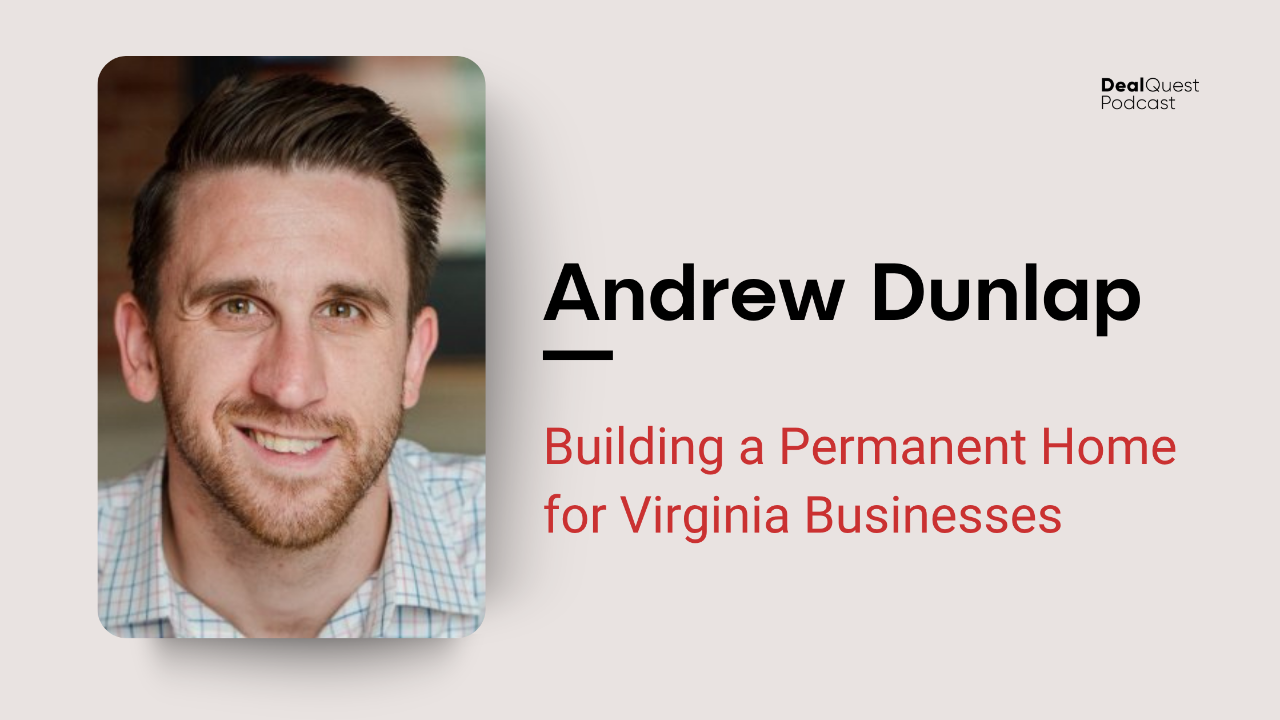
Most people who want to fix a problem this big think about running for office. Andrew Dunlap looked at the same problem and decided to build a holding company instead. When he studied the merger and acquisition data in his home state, he found that in Roanoke, 87 percent of external buyers were out-of-state, and across Virginia, 82 percent of all transactions were completed by an out-of-state buyer. Every one of those deals carried the risk of taking the company, its leadership, and its economic footprint somewhere else. So Andrew set out to become a different kind of buyer, one that keeps established Virginia businesses in Virginia.
Andrew is the founder and CEO of Harbor, and in the span of a few months he acquired a CNC machine shop, a FINRA-registered broker dealer, and moved toward closing on an industrial services company. He came to this work almost by accident, coming out of a venture-backed startup in early 2024 and asking a simple question about why his region had so few career pathways. What he built in response is a long-term, buy-and-hold company structured to grow investor wealth while keeping leaders, jobs, and capital rooted in place. Whether you are an owner thinking about succession, an investor weighing a longer time horizon, or an operator trying to grow a business without breaking it, this conversation offers a grounded look at how deal structure and genuine values can work together.
THE LAWN-MOWING NEGOTIATION
Andrew's first deal happened years before he ever pulled a database. As a kid, he struck an arrangement with a neighbor who needed his grass looking good for a party. Rather than charge the standard rate, Andrew proposed a package. He would normally charge one price, double it for two cuts, but if they booked both within a week, the neighbor got a bulk rate. It was a two-for-one built around the customer's real deadline.
That instinct, finding the structure that works for the person across the table, shows up throughout everything he does now. The mechanics have grown more sophisticated, but the underlying move is the same. Understand what the other side actually needs, then design terms around it.
STUMBLING BACKWARD INTO A HOLDING COMPANY
Andrew describes his path into this business as a crazy story, and one he did not set out to replicate from a playbook. Coming out of a venture-backed startup based in Richmond in January of 2024, he looked around Roanoke and noticed there were very few senior roles to step into. Instead of accepting that, he asked why. He lives in the southwest part of the state, moved there ten years ago from Baltimore, and could see the region was resource rich yet short on career pathways.
Being, in his words, the kind of nerd who digs into data, Andrew pulled databases and started tracing who was buying the companies that used to anchor the region. Advance Auto Parts started in Roanoke. GE and Norfolk Southern once had a major presence. Many of those companies were gone. The buyers, it turned out, were overwhelmingly from out of state. That single finding became the foundation for a business built to reverse the trend.
WHAT HAPPENS WHEN THE HEADQUARTERS LEAVES
Once Andrew saw where the companies were going, he wanted to know whether it actually mattered. The research he found pointed to a clear economic effect. When a company keeps its headquarters in a particular place, he explained, roughly 52 to 53 cents of every dollar of revenue recirculates in that community. Move that headquarters to a tier one city, and the figure drops to around 14 cents.
The result is a slow outmigration of talent, capital, and businesses from smaller cities toward a handful of large ones. Andrew's concern is what those tier three and tier four cities look like fifteen or twenty years down the road if the pattern continues. Do they still have capital, people, and businesses, or do they become tourist destinations. For any leader thinking about regional growth or civic impact, the recirculation figure reframes what an acquisition really moves.
BUILDING A PERMANENT HOME FOR VIRGINIA COMPANIES
Andrew considered the legislative route and decided against it. From a free-market perspective, he did not want to regulate how deals get done. He wanted to build an alternative that competes on its own terms, a permanent holding company for Virginia that buys companies in the state to keep them there, then recruits the next generation of leaders back to run and learn inside those businesses.
The pitch to owners is refreshingly direct. When you sell, Andrew tells them, you have roughly three options. A strategic buyer who rolls you into something bigger, a private equity firm with its own mandate and timeline, or a buyer like Harbor that intends to keep your team in the town where it was built. When he frames the choice that way, owners consistently gravitate toward the option that protects the legacy they spent decades building. This is the same tension Corey has explored with Richard Manders around private equity roll-ups, where some buyers aggregate purely for a multiple arbitrage exit while others genuinely add value. Andrew is deliberately building on the value-adding side of that line.
THE UNTIMED FUND AND CAFFEINATED DECISIONS
Andrew's fund structure reflects the same long-term thinking. Traditional funds run on a clock, and that clock, he argues, becomes a gun to the head that forces what he calls caffeinated decisions. Those choices can look great in the short term and leave the town, the jobs, and the company exposed when the caffeine high wears off and the fund has already exited. That decision matrix was unacceptable to him, so Harbor went a different way.
Rather than raise a blind pool of capital and race a timer, Harbor built an open-ended, untimed fund and found the deals first. Andrew brings a specific opportunity to investors, secures commitments, and deploys that capital into the acquisition. The structure carries no assets-under-management fees, distributes cash to investors every year, and includes a seven-year secondary window, which means investors can theoretically exit sooner than in a traditional fund while avoiding the fee drag that eats into returns over a decade. His LPs range from family offices to high-net-worth individuals, with institutional conversations underway.
A DIFFERENT KIND OF BUYER AT THE TABLE
Flexibility is central to how Harbor approaches owners. Andrew comes in transparently and tells the owner that Harbor wants to be the next legacy holder of something they bled over, treating the business almost like a family member. From there the structure can flex. Harbor can buy all of it or most of it, though it typically wants at least a majority so it is a real partner rather than a passive minority. Earnouts, seller financing, a full equity slug, debt or no debt, the terms bend to fit the owner.
In exchange, Andrew is equally clear about what Harbor needs, a fair return for its investors on a cash-on-cash basis year over year. Sometimes the numbers simply do not pencil, and in those cases he is comfortable telling an owner that a private equity firm paying a much higher multiple might be the better fit. So far Harbor has completed three deals, each with a different flavor, different post-close arrangements with the owners, and different financing. The through line is a posture of sitting on the same side of the table rather than across it.
THE CLARK PRECISION MACHINE PARTNERSHIP
One acquisition captures what Andrew is trying to prove. Clark Precision Machine, a metal fabrication business in a small Southwest Virginia town, came together when the stars aligned. The county wanted to keep the company local. The owner, in his early 50s, wanted to take some chips off the table while continuing to grow, and he wanted additional minds in the room to think through scaling challenges and hard-to-reach customers. Harbor arrived at the right moment with growth capital and marketing horsepower to help move the shop from roughly 75,000 parts a year toward 100,000 without wrecking the team or the culture.
The proof showed up in the owner's own behavior. He had braced for a shoe to drop, expecting the hammer to come down once the deal closed. Day one passed and nothing happened. By day thirty he thought it was going well, and by day seventy-five he called it a really great partnership. He has since signed a five-year contract to keep running the business and posted publicly on LinkedIn about the experience. For any owner nervous about staying on after a sale, this is a concrete example of what a values-aligned transition can look like.
THE DEALS THAT GOT AWAY
Andrew was candid about the ones that hurt. In the first, Harbor got deep into talks for a manufacturing company based right in Roanoke, part of a European conglomerate, with a team and a leader he genuinely admired. Then the broker called to say everything had stopped, and no one could explain why. Months later the answer surfaced in the European press. Samsung had acquired the European parent, and the whole process froze. His takeaway is the oldest lesson in dealmaking, that it is not done until it is signed and the money is wired.
The second one left a deeper scar. Harbor courted a company for about six months, shared its post-acquisition plan in detail, including a partnership it envisioned with another local business, and used that vision to build the owner's comfort. Then the deal died suddenly. A couple of months later it became public that the target had, in Andrew's account, broken NDAs and merged with the very company whose partnership Harbor had described. The lesson he drew is a hard one, be transparent, but do not overshare, or you risk handing someone the solution and getting cut out of it. Corey's response reframed the pain usefully, that if people would behave that way, it is probably a gift not to end up in business with them.
THE RED FLAGS THAT KILL A DEAL
After looking at far more companies than he buys, Andrew has a clear sense of what sinks a deal. One is the missing sales function or the absent general manager. An owner will claim the team can run things day to day, and a few questions later it becomes obvious the owner still runs everything and the team knows it. That gap between what the owner believes and what the staff say is a red flag, and it raises the question of what else the owner might be misjudging.
The other recurring problem is the hockey stick, the flat or steady revenue line that magically bends to 35 percent growth the moment after the sale, with the owner expecting to get paid up front for growth that has not happened. Andrew and Corey landed on the same test for this. If the owner truly believes the growth is coming because of specific, identifiable factors, then structure it as an earnout. A confident seller signs up for that gladly. A hesitant one tells you the forecast was a bluff. This mirrors a theme Corey returns to often, that understanding what buyers actually look for gives sellers a roadmap to build real enterprise value in the years before they go to market.
WHY TRUST IS THE ONLY CURRENCY THAT MATTERS
Asked what he watches in a volatile market, Andrew gave an unusual answer. Assets can turn, revenue streams can dry up, and even a smart bet can get merged out of existence, but trust built through relationships is the one stabilizing factor that holds. He offered a vivid example. When tungsten prices spiked dramatically because of China, hitting his machine shop hard, Harbor had a congressman's number it could call to come walk the shop floor and talk through options. That kind of access, he says, has no price tag.
Andrew's practical prescription is to build relationships and be known, which is why he writes regularly on LinkedIn about what Harbor is doing and who they are. He pointed to Corey's own podcast, now past four hundred episodes, as a template for earning trust by giving value away for free. For business leaders, the message is that deepening trust with as many people as possible is not a soft activity, it is what stabilizes revenue and opens doors when markets get strange. That emphasis on legacy and stakeholder alignment echoes what Corey has explored with Kelly Finnell around ESOPs as a way to preserve a company's culture and independence, and with Gerry Hays around why geography should not determine who gets access to capital.
Tune in to this episode to hear Andrew Dunlap share how he turned a data question into a holding company built for the long term. From the economics of where a headquarters sits to the fund structure that avoids caffeinated decisions, this conversation offers business leaders a fresh model for buying and building companies without extracting them from the communities that made them. If you want to go deeper on the private equity comparison, revisit Corey's conversation with Richard Manders on roll-ups, and for a complementary take on legacy-preserving ownership, check out the episode with Kelly Finnell on ESOPs.
Listen to the full episode of DealQuest Podcast with Andrew Dunlap: [Available on all major podcast platforms]
FOR MORE ON ANDREW DUNLAP
LinkedIn: https://www.linkedin.com/in/dunlapandrew/ Company: https://harbor.capital
FOR MORE ON COREY KUPFER
https://www.linkedin.com/in/coreykupfer/
Corey Kupfer is an expert strategist, negotiator, and dealmaker. He has more than 35 years of professional deal-making and negotiating experience. Corey is a successful entrepreneur, attorney, consultant, author, and professional speaker. He is deeply passionate about deal-driven growth. He is also the creator and host of the DealQuest Podcast.
Get deal-ready with the DealQuest Podcast with Corey Kupfer, where like-minded entrepreneurs and business leaders converge, share insights and challenges, and success stories. Equip yourself with the tools, resources, and support necessary to navigate the complex yet rewarding world of dealmaking. Dive into the world of deal-driven growth today!

