
The DealQuest Quarterly Roundtable With Brian Meegan And Sara Mostafa
Oct 07, 2026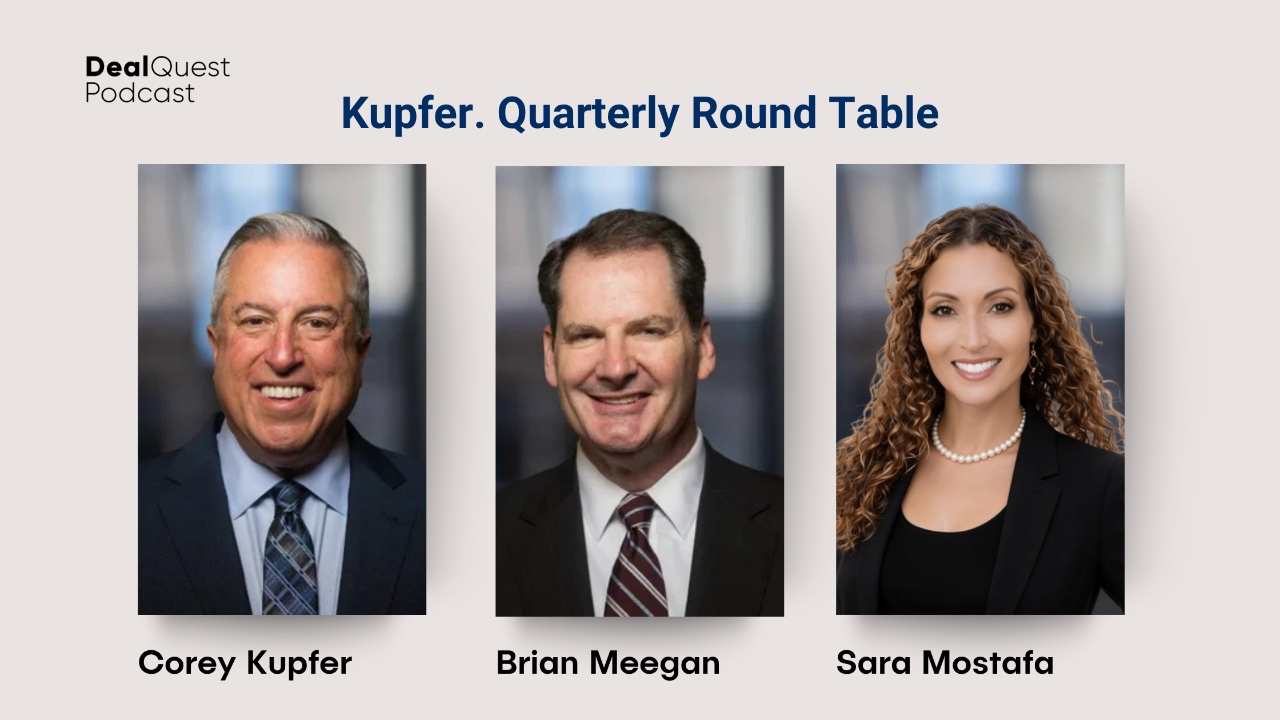
There is more capital sitting in private markets than most of us have ever seen, and much of it has nowhere obvious to go. IPOs are down sharply, exits are getting delayed, and firms that raised big funds are under real pressure to put money to work. That combination is reshaping how deals get structured, who gets funded, and what sellers actually walk away with.
This is our second quarterly deals roundtable, recorded in early September with my partners Brian Meegan and Sara Mostafa, covering what we saw across the deal world in Q2 2026. We move from the macro picture to what is happening on the ground in the lower middle market, then into two segments we love, Brian's deal in history and a new one from Sara on remarkable women in business. I close with a story about a founder who decided not to go public, and why that decision mattered more than the money.
A Market Full Of Money With Nowhere To Exit
I just got back from the Echelon Deals and Dealmakers Summit, and a theme that keeps building is the rise of continuation funds in private equity. There is a large amount of dry powder that has not been deployed, and much of the capital already deployed has seen far less monetization than sponsors expected. When you cannot sell or take a company public, continuation funds become one of the ways that money keeps moving.
Part of what is driving this is the IPO market. Louis Schiff noted at the conference that the overall number of IPOs is down dramatically from years past. Public offerings are not the only exit vehicle, but as you climb the sponsor ladder they matter, and when that door narrows, private capital has to find other routes.
When Cash Gives Way To Earnouts And Rollover Equity
Sara opened with a trend we have watched build over several quarters, a steady shift of risk onto sellers. The easy cash of the past, where a large share of the purchase price landed at closing, is much harder to find.
In its place we are seeing more complex structures, with earnouts and rollover equity making up a meaningful portion of the consideration that used to come as cash. For sellers, that changes the entire calculation of what a deal is really worth and when they actually get paid.
The IPO Numbers Behind The Shift
Brian put hard numbers on the exit slowdown. Between 2017 and 2021 there were 424 private equity backed IPOs. Between 2022 and the present there were 70, according to Dealogic. That is a steep drop, and it lines up with everything we are seeing in the market.
The changes that came with rising interest rates, along with the disruption of recent years, have had a lasting impact. There was optimism early in the year that rates would keep easing and momentum would build, but that has not played out cleanly. By the historical data within this year the market for mergers and acquisitions is still strong, yet the headwinds keep arriving, and how they land by year end is an open question.
Why The Lower Middle Market Is Suddenly Flush
Globally, deal volume is down while total deal value is up, because a smaller number of very large deals are carrying the value figure. The lower middle market tells a different story. Axial reported a record 3,523 deals coming to market in Q2 2026, up roughly 4.79 percent over the same quarter last year.
The mechanism is simple to see once you follow the money. Funds face real consequences if they fail to deploy capital, so when the mega deals fill up, money moves to large deals, then to the middle market, then down into the lower middle market. That creates a genuine opportunity for smaller companies to raise capital that would have been far less available in a market where dollars stayed at the top and the IPO window was wide open.
The New Math Of Diligence And Longer Holds
Sara flagged a confounding variable in all of this, closing timelines that have stretched dramatically, sometimes to three times what used to be standard. A big driver is technology diligence. Buyers now dig hard into the hygiene of the IP they are acquiring, asking whether code was built from unlicensed or open source sources, and that scrutiny, along with federal and California state regulatory changes, is slowing deals down.
Brian pointed to the other side of the same coin. The old data rooms, once literal rooms full of boxes, are virtual now, and AI can run analysis in minutes that used to take days. So AI is a positive and a negative force at once, adding efficiency while raising the bar for what buyers need to understand.
The holding problem shows up in the portfolio data. A New York Times piece in August reported that as of June 30, private equity firms held 33,575 unsold companies, up from about 32,500 a year earlier, and roughly 15,923 a decade ago. Firms do not want to lock in losses on companies that have not reached their value, so they hold longer, and average returns come down. A good deal of that pressure traces back to software, the darling of a few years ago, now squeezed as AI resets what those companies are worth.
What Minority Investors Really Control
Sara was recently quoted in Family Wealth Report by Charlie Baker on minority investments, and it opened up a point worth underscoring. Founders sometimes assume that taking a minority investment means they keep full control. On the day to day, they usually do run the company. On the biggest decisions, that assumption often does not hold.
Minority investors negotiate board seats, veto rights, tag along rights, ratchet rights, and priority investment rights, and they should. If you are the founder or management team taking that money in, you have to understand that real capital almost always comes with some real say. We are also seeing new entrants make these minority moves, including family offices and even sovereign wealth groups, with Sara emphasizing the importance of a board seat or management right plus a cash out option tied to triggering events like an acquisition.
The Part Of Selling No One Prices In
Echelon ran surveys on how sellers felt after closing, sorting responses into fell short, met expectations, and exceeded expectations. The largest fell short category, at 40 percent, was not the earnout, the equity performance, or the deal economics. It was autonomy and workload.
Sara is seeing the same thing on the ground in San Diego, where consolidation across service businesses like HVAC and plumbing increasingly requires founders to stay on for 24 to 36 months. Going from king or queen of your own company to an employee inside a larger organization carries an emotional toll that rarely shows up in the model, and after 35 plus years of doing these deals, I can tell you some of that friction is simply built into the shift.
A Deal In History, How US Steel Came Together
Brian's history segment went back to a cold night in December 1900, when roughly 80 American financiers and industry leaders gathered for dinner at the University Club on Fifth Avenue. Andrew Carnegie hosted and left early, and his president Charles Schwab, not the wealth management name, stood up to cast a vision of vertical integration across steel, from iron ore mines through rail, stamping, and forging, that would become US Steel.
The real target in the room was J.P. Morgan, seated beside Schwab, who was so captivated that he reportedly forgot to light his cigar for the full hour. Schwab later took Carnegie golfing, made sure not to beat his boss, and carried the pitch. Carnegie thought it over, wrote 480 million dollars on a scrap of paper in pencil, and handed it back. Morgan accepted, walked over to Carnegie's house, and the handshake took about fifteen minutes.
The lessons carry straight into deals of any size. Know your number. Do the pre negotiation groundwork. Use the right intermediary, because it was never going to be Carnegie and Morgan negotiating hat in hand. Clarity is the first piece of the framework in my authentic negotiating work, and when your number is at or above what you truly want, accepting a clean offer without letting ego drag it out can be its own kind of discipline.
Remarkable Women In Business, Starting With Estée Lauder
Sara launched her new quarterly segment on remarkable women in business, beginning with Estée Lauder, born Josephine Esther Mentzer in Queens from humble beginnings. She was inspired watching her uncle, a chemist, develop skin creams in the family kitchen, and she started by selling his products to women sitting captive under the dryers at local salons.
She and her husband built their own line around four core products, and the first big break came in 1947 when Saks Fifth Avenue placed an 800 dollar order. She pioneered marketing that is now standard, trying products directly on customers and the free gift with purchase. The business went international by the 1960s, went public in 1995, and today posts annual net sales of about 15 billion dollars. I love founder stories, and I am glad Sara is putting a spotlight on ones that too often go untold.
No Default Path
I recently had dinner with a very successful founder whose company runs about 440 to 450 million dollars in revenue, and who was weighing whether to go public. A friend had pulled together a small brain trust of us through EO to give him time and help his thinking. Where others offered good tactical advice, I spent our time on the inner journey and walked him through the context, purpose, and results work from my negotiating book.
He got clear that he was not going public. He had built a culture and created real opportunity for people who rose up inside the company, and none of that was worth trading for the pressures of the public markets. It reminded me of Sunny Vanderbeck in Episode 293, who wrote about selling without selling out, and of the internal succession paths Kelly Finnell laid out in Episode 325 on employee ownership. There is no default path from build to scale to raise to exit. Deals are a tool, not an obligation. As Sara put it, growth without a purpose is not very meaningful.
WANT TO BE A GUEST ON DEALQUEST?
Apply here: https://beaguestondealquest.com
Listen to the full episode of DealQuest Podcast with Brian Meegan and Sara Mostafa. Available on all major podcast platforms.
Corey Kupfer is an expert strategist, negotiator, and dealmaker. He has more than 35 years of professional deal-making and negotiating experience. Corey is a successful entrepreneur, attorney, consultant, author, and professional speaker. He is deeply passionate about deal-driven growth. He is also the creator and host of the DealQuest Podcast.
Get deal-ready with the DealQuest Podcast with Corey Kupfer, where like-minded entrepreneurs and business leaders converge, share insights and challenges, and success stories. Equip yourself with the tools, resources, and support necessary to navigate the complex yet rewarding world of dealmaking. Dive into the world of deal-driven growth today!

