
How to Make a Business Partnership Work and Exit Well with Corey Kupfer
Sep 09, 2026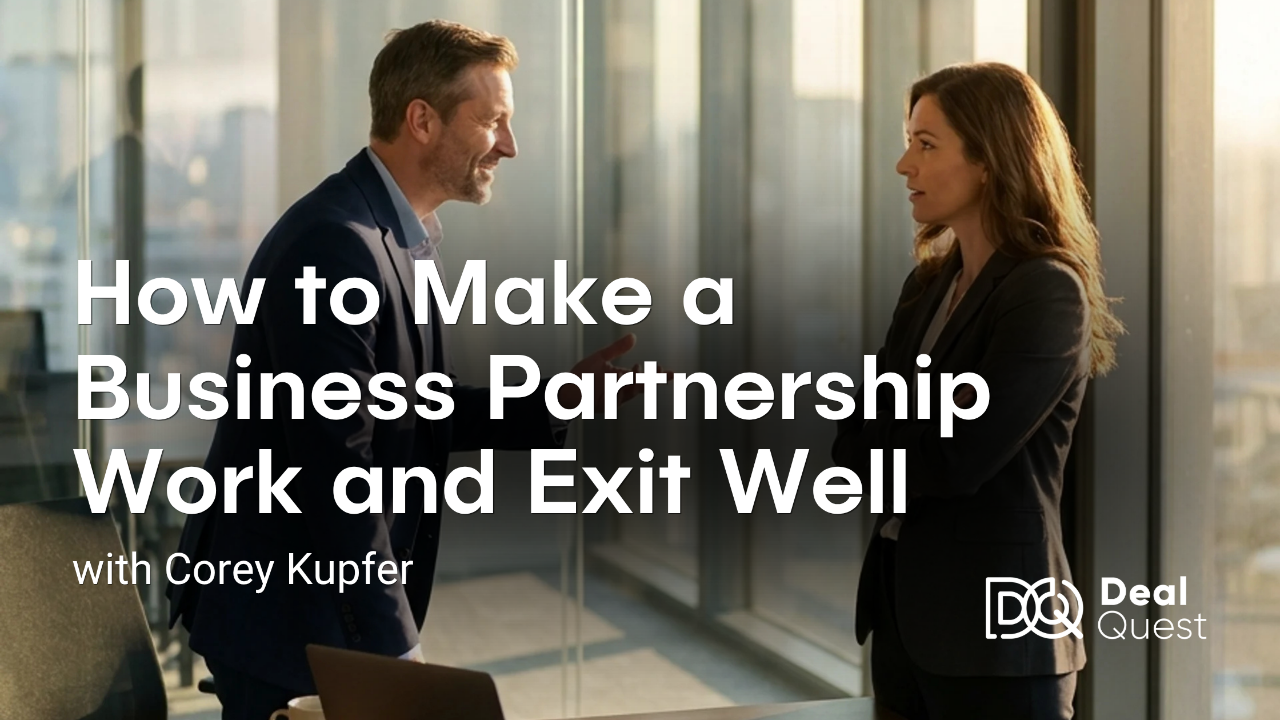
A business partnership is often the very first deal an entrepreneur ever does. Long before the M&A, the capital raise, or the joint venture, two or more people decide to build something together and share ownership in whatever form that takes, whether it is stock in a corporation or membership interest in an LLC. It is a fundamental deal, and it is one I have lived on every side of.
In this solocast I wanted to step back from the usual deal categories and talk about what it actually takes to be in a business partnership. I have been in several partnerships across different businesses over the years. Some worked beautifully. Some did not. On top of my own experience, my firm has helped create the documentation for countless new partnerships, evolved those agreements as companies grow and bring in junior partners or new equity classes, and guided partners through separation when the time comes. I want to share the pattern I keep seeing, so you can go into your next partnership with your eyes wide open.
Do The Due Diligence Even When You Think You Know Them
No matter how a partnership forms, there is always due diligence you should do. Sometimes people come together strategically without knowing each other well, and you need to look into background, experience, and whether there have been past issues like lawsuits, bankruptcy, or tax liens. You also want financial due diligence on whether a partner can make a required capital contribution and whether they can handle a period where the company is not yet profitable.
The part people skip most is the cultural and personal due diligence. Can you actually work together, and do you share vision and values. There are whole books written on cultural fit, and despite all of that, it is still something people get wrong. Even if the person is your college buddy, your neighbor, or a family member, you may not need the personal due diligence, but you still owe it to yourselves to sit down and talk specifically about this venture. Why are you coming together, are the visions and values aligned, and do you share the same goals, timelines, and future plans. That body of work almost always needs to be done, and people routinely skimp on it.
Move Fast When You Have To, But Do Not Skip The Work
I am realistic. In a perfect world you complete all of this before you start, but sometimes an opportunity has to be seized quickly. Maybe it is a real estate property, or a company that becomes available because an owner has a health issue. There are a million reasons opportunities come up that force you to act before you can finish full due diligence.
When that happens, do as much as you can upfront, and then keep going after you close. It is far better to find out early if there are issues and deal with them, or figure out that you cannot, than to bury the process because the deal is already done. That work upfront, and the willingness to continue it, is crucial when you are getting into a partnership.
Partnerships Evolve, And So Do The People In Them
People talk about a marriage where the couple just grew apart. The same thing happens in business partnerships. There may have been a very good reason to come together in the beginning, with real alignment, and then the business evolves, the people evolve, and the partnership evolves.
I usually say it is smart to follow where the market and the clients are taking you. If your clients are asking for a different product or service, or want you to focus more on one industry than another, some of the most successful companies listen and move that way. The catch is that this evolution can pull one partner into alignment with the new direction while another partner is left behind, even though they started out aligned. You then have to figure out whether you can keep evolving together or whether it is time for a change.
When Growing Apart Is Nobody's Fault
I know of a PR firm, and I will not mention names, where two partners built something very successful. One partner realized that the bigger, more scaled version of the company was not actually his joy spot. His sweet spot was bespoke, customized, deeply client connected work. Even though the firm had grown well past that vision, he recognized that scale was not what he wanted to be doing. So he negotiated a deal, his partner bought him out, she went on to grow and run the bigger vision, and he started a new firm that fit his own alignment. Everybody got what they wanted.
In another situation, two partners had very different personalities that actually made them a strong team. One was much more of an operator who made sure the work got done and built the culture. The other was a business developer with the bigger vision. That can be a great combination, but they ran into real differences over how things should be run, and they ended up splitting. Stage of life plays into this too. When one partner is forty and one is thirty two, the gap may not matter at first because you both have a long runway. Fast forward twenty five years and someone's circumstances change. They want to work less, move their family, or make a different decision, while the other partner is still in build mode.
The Agreement Is A Roadmap, Not A Guarantee
From a lawyer's point of view, it is easy to say you should anticipate all of this in your deal documents, whether that is an operating agreement for an LLC or a shareholders agreement for a corporation. And you should try. You will put in provisions for what happens if partners cannot agree, if someone wants to leave, or if there is a triggering event, and you will decide on a methodology for a split, a buyout, or a bidding process.
Here is the honest truth. It is hard to anticipate every variation of why a split might occur or exactly what the tailored solution should be. The document will save you headaches and give you a roadmap if you have to separate, but whether you actually stay together, work it out, and grow is not something you can govern in a document. That comes down to the level of trust and respect in the partnership, the ability to communicate, and each person's willingness to evolve.
What Partnerships Give You That Employees Never Will
The real benefit of a partnership is having someone who is as committed, as vested, and as all in as you are, so the weight is not carried by you alone. Some people say you can just hire for the skills you lack, and to a point that is true. But there is something that is consistently true, and I often have to remind earlier stage entrepreneurs of it. No employee is ever going to have the same level of commitment, dedication, and ownership that you have as the entrepreneur.
I am blessed with a phenomenal team that cares about my businesses as much as any employee possibly could. And it is still not the same as having a partner, because they are not financially at risk. They are not putting up the money or making sure payroll gets met. A partnership is, in many ways, like a marriage. The commitment is bigger, you share the upside, and you make joint decisions, but you can reach a level of shared ownership that is very hard to get any other way.
Know Yourself Before You Say Yes
There is a flip side, and I will be honest about it. When I split up my last partnership, I used to joke that it was good to be king again. I am a deeply collaborative person. I love working with a team and getting input. But being the ultimate decision maker, able to create something in my vision, treat clients and industry partners the way I want, and build the culture I want without needing alignment from a partner, feels good.
So you have to know yourself, and know in what circumstances a partnership is the better model for you. It is worth noting that some private equity firms, venture capital firms, and investment bankers actually prefer to invest in multi founder companies. They do not want the business relying on one person. They want more people vested, with different skills bringing different things to the table. Whether that is right for you depends entirely on you and on the partnership.
Splitting Up Without Blowing Everything Up
I have been through partnership separations across the entire spectrum. My first law firm partnership, formed back in the nineties, ended with some tension and differing views, but we worked out a split, kept sharing office space because the lease continued, ran our own firms out of that space, and let clients choose where they wanted to go. It was a smooth transition. My real estate investment partnership with Dan did not really split at all. We went into the great recession, did well on some deals and not on others, kept the partnership strong the whole way through because of superb communication and aligned values, and simply closed the funds when the time came. My last partnership, which ran from 2010 to 2015, went the other way, with vengeful behavior on the other side that made it painful.
That range is exactly why I feel so strongly about how you separate. As an attorney, I get called in to represent one partner against another, and while we do not litigate in house, we more often get brought in to negotiate an exit. It is rarely the best choice to litigate when you split a business. The damage to the business, the clients, and employee retention is often so great that everybody loses. If people can set their egos aside, each give a little more than they expected, and move on as human beings, the outcome is better for everyone. What we almost never account for is opportunity cost. We can calculate the lawyer's bill, but we leave out the distraction, time, energy, and emotion that a fight drains from you, your employees, and your clients.
This is where the process from my book Authentic Negotiating comes in. I use a framework I call CPR, which stands for context, purpose, and results. It is a way to get crystal clear on exactly what you want out of a situation, whether that is a deal, a partnership split, or really any area of life. When I am brought in as a mediator, I take both sides through it so they get clear on the results they want, their purpose, and the context they choose to hold. Do they want to be vengeful and angry, or do they want to hold a more empowering context that leads to a more amicable result. When people are willing to do that work, it is amazing how a situation that could have been a disaster becomes a far better experience, sometimes even one where the partners keep a relationship.
Whether a partnership is the right move for you now, later, or not at all is a decision only you can make. There are benefits and detriments to it. Go in eyes wide open, get as clear an agreement as you can upfront, keep communication high, and keep checking whether the partnership is still in integrity and alignment for you. Personally, I am the only owner of my firm and I am happy there, but I have other ventures I would consider partnering on. A partnership is a tool on the table that can be genuinely beneficial as long as you understand the downsides and work to minimize them.
If you want to go deeper on structuring these kinds of deals, my solocast on the full spectrum of deal types (Episode 351) breaks down joint ventures, strategic alliances, and the exit provisions that function like a partnership prenup. Devan Gonzalez shared a great real world example in Episode 336 of how he and his partner set up a clear conversation to keep friendship and business separate. And for the emotional side of exits and separations, Jodi Hume's conversation in Episode 366 is well worth your time.
Tune in to this solocast to hear how business partnerships really work, from the due diligence most people skip to the negotiated exits that let everyone move on with their dignity intact. From forming the partnership to evolving it to ending it well, this is the higher level conversation on a deal type that touches almost every entrepreneur.
Listen to the full DealQuest Podcast episode here
FOR MORE ON COREY KUPFER
https://www.linkedin.com/in/coreykupfer/
https://www.coreykupfer.com/
Corey Kupfer is an expert strategist, negotiator, and dealmaker. He has more than 35 years of professional deal-making and negotiating experience. Corey is a successful entrepreneur, attorney, consultant, author, and professional speaker. He is deeply passionate about deal-driven growth. He is also the creator and host of the DealQuest Podcast.
Get deal-ready with the DealQuest Podcast with Corey Kupfer, where like-minded entrepreneurs and business leaders converge, share insights and challenges, and success stories. Equip yourself with the tools, resources, and support necessary to navigate the complex yet rewarding world of dealmaking. Dive into the world of deal-driven growth today!

