
How to Maximize Your Company's Sale Value with Greg Waller
Feb 18, 2026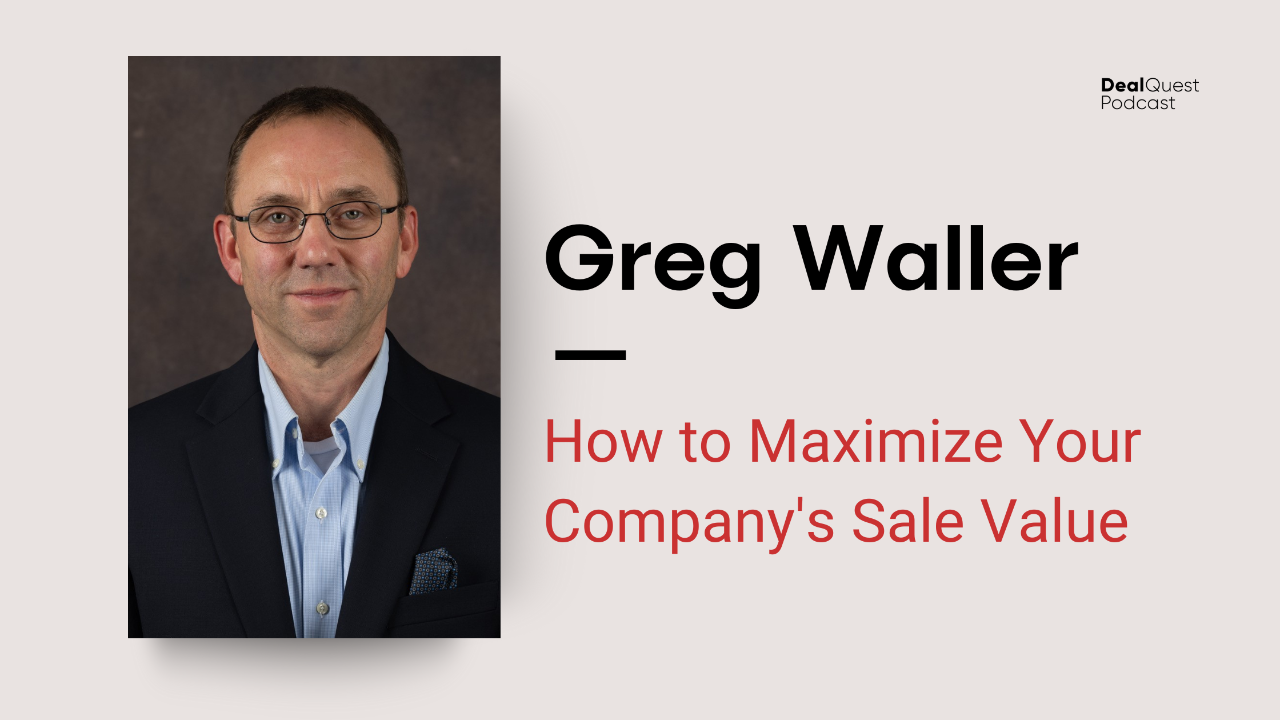
In this episode of the DealQuest Podcast, I sit down with Dr. Greg Waller, who advises clients on complex business valuation and buy-side and sell-side M&A transactions. Greg is the son of a blue-collar entrepreneur and was raised in his family's industrial painting equipment distribution company. He owned and operated an industrial painting company that specialized in painting elevated structural steel infrastructure like bridges and tanks. He's also been a partner in a real estate development firm, and until recently was a partner in a restaurant operating group.
After leaving the blue-collar world, Greg earned his MBA and PhD in finance, spent 20 years in academics teaching at Ohio University and Virginia Commonwealth University, and now runs Cornerstone Valuation and HG Waller Transact Capital. He's built a 20-person team that focuses on M&A advisory and business valuation in the lower middle to middle market. Whether you're considering a business exit in the next few years, wondering how to maximize your company's value, or navigating the complexities of professional buyers versus owner-operators, this conversation provides practical insights from someone who's seen both sides of the table.
FROM PAINTING BRIDGES TO VALUING BUSINESSES
Greg's journey started in a very different place than most M&A advisors. He grew up in his father's industrial painting equipment distribution business and spent years actually painting bridges and elevated structural steel. As he puts it, "we painted stuff that was up in the air, and typically way up there, way up high."
After high school, he worked in commercial real estate development while pursuing his MBA. Then someone at a country club asked him a simple question about why he wasn't pursuing more education. That conversation changed everything. Greg went on to get his PhD in finance at Purdue University, where a real estate agent told him something prophetic: "Honey, you're a salesman, you're not a professor."
She was right. While Greg spent 20 years in academics, he always had his hands in entrepreneurial ventures. He maintained the valuation practice, did real estate development, eventually bought his father's distribution company, and built a restaurant operating group. The combination of blue-collar work experience, academic rigor, and hands-on business ownership gave him a perspective most M&A advisors simply don't have.
THE BLUE-COLLAR SCHOLAR ADVANTAGE
Greg uses the phrase "Blue-Collar Scholar" deliberately. Having been under the hood of companies both as an owner-operator and through valuation work, he can look at businesses from angles that traditional investment banking analysts might miss.
The blue-collar background gives him something specific: "I'm as comfortable talking to the janitor as I am to a board of directors, and just being able to put yourself in those shoes and having done it, I think, really gives you a different perspective." This isn't just about rapport. Understanding operations from the ground up means spotting value drivers and risks that only show up when you've actually done the work.
The scholarly side brings the technical expertise in valuation methodologies, M&A processes, and financial analysis. Combined, Greg can get into the head of sellers in ways that matter when emotions run high and expectations need managing. For business owners who've spent decades building something from nothing, having an advisor who actually understands what that journey feels like makes difficult conversations possible.
TWO TYPES OF BUYERS, TWO DIFFERENT PROCESSES
Greg breaks the M&A market into two distinct buyer pools, and understanding this distinction shapes everything about how he approaches deals. Professional buyers include private equity firms and strategic acquirers. Owner-operators represent the other category.
When appealing to owner-operators, the process often leads with price. "You're putting it out on Axial, or BizBuySell, or your website, and hanging a price on it," Greg explains. Many advisors excel in that space. But Greg's firm focuses on the more structured process targeting professional buyers.
For companies in the $10 to $200 million enterprise value range, the process requires rigorous due diligence, sophisticated project management, and the ability to create competitive auction dynamics. "We obviously know the numbers well, we understand the process, and we can go out and create that competitive auction process for our clients."
His team of 20 focuses on specific verticals: human resource companies, staffing companies, industrials and infrastructure, healthcare, technology, and consumer products. Being in Richmond, Virginia, they're also triangulated between DC and Norfolk, which brings significant government contracting work.
THE VALUE VERSUS PRICE CONVERSATION
This is where Greg's experience becomes crucial. Coming from a pure valuation background, he can assess what a company is worth. But he always stresses to clients that there's a fundamental difference between value and price.
He uses the GameStop example: "The price went through the roof, and then when the market realized that nothing fundamental changed about the company, the stock price dropped." Setting expectations at the beginning of the process protects everyone from painful surprises later.
Greg provides clients with his best estimate on a range of values, but with a critical caveat: "If this thing ends up pricing at the lower end of the range, are we still good to go?" Everyone's incentivized to maximize price, but the market ultimately determines what buyers will pay.
Problems arise when there's a disconnect between the expectations Greg sets and what clients actually acknowledge. Sellers might say, "You looked at this thing, you're a valuation guy, you told me it was worth X, and the market's coming back and it's not pricing it accordingly." That's why Greg constantly reinforces: "This is my estimate of what it's going to bring in the market, and I can't really dictate what the market's going to do."
PREPARING BUSINESSES FOR SALE
The deals that go smoothest are often the ones that began as conversations years before the actual sale. Greg takes a consultative approach where some of his best deals were "3 or 5 years in the making, where we got in early, we did some valuation work, identified value drivers."
It might start with something simple: "I'm thinking about gifting stock to my kids." Greg comes in on a valuation engagement, and the conversation evolves to, "Maybe we're actually thinking about selling this thing." That's when the real work begins.
If a business is considering going to market, there are always things that need cleaning up. Working with clients over several years, helping them get their house in order, means that when they're finally ready to pull the trigger, "We're their first call, because we've worked with them for the past couple years, helping them get their house in order, and then it's a relatively easy process to get it packaged up to go to the market."
Greg tells clients: "The best time to start thinking about when to hit the market is 3 years ago." This approach echoes what Tom Dillon shared in his episode about understanding the full lifecycle of SMB businesses and planning for transitions well in advance. The companies that maximize their value are the ones that treated exit preparation as a multi-year project, not a six-month sprint.
THE BLURRED LINE BETWEEN FINANCIAL AND STRATEGIC BUYERS
When I ask Greg whether his deals typically involve financial or strategic buyers, he immediately notes: "That line is getting so blurry now. It's getting really, really blurry."
The majority of buyers for his companies are "private equity-backed platforms that kind of act like strategics." For example, a recent transaction in the water infrastructure space involved an HIG-backed company. "It was a big company, and they acted a lot like a strategic, right? So they were bolting on competitors, essentially."
This hybrid model has become dominant in the middle market. PE-backed platforms bring the financial discipline and resources of institutional capital, but they're making strategic acquisitions to build scale and capabilities. As Kelly Finnell discussed in his episode on ESOPs and buyer types, understanding these distinctions matters because they affect everything from valuation multiples to deal structure and cultural fit.
Greg did note one upcoming deal with a pure European strategic buyer, not private equity-backed. Those deals bring their own complexities.
INTERNATIONAL DEAL COMPLEXITIES
I always enjoy working on international deals, and Greg has his share of stories. The first priorities when working with international buyers: "What accounting standards are we working on, and who's doing the legal work, and where?"
In a recent European deal, one interesting wrinkle emerged around compensation expectations. "The folks in the U.S. for our client were making significantly more money than the top people at the European company." Structuring key player retention and compensation in that context required creativity and cultural sensitivity.
I shared some of my own international deal experiences, from the Japanese buyers who needed special pens to sign with (as a memento of the deal) to German buyers who hand-initialed every single page of thousands of documents in hard copy. Each culture brings different expectations and practices. The Foreign Corrupt Practices Act compliance issues also surface more frequently in international transactions.
These deals add complexity, but they also expand the buyer pool and can bring premium valuations when strategic fit is strong.
MARKET CONDITIONS AND THE 2026 OUTLOOK
Greg's market perspective is informed by real-time activity. Through April 2025, he thought the year would be "a total write-off, with all the turmoil in the markets." But things shifted mid-summer. "The tide kind of started to shift for us, so things started really opening up July, August."
Interest rates have settled into reasonable ranges. While we won't see 2% rates again, "The market has settled in on reasonable, required rates of return for debt financing." That stability helps.
Labor-intensive businesses are attracting significant attention. With immigration policies creating labor challenges, companies with skilled workforces are "getting gobbled up for really high multiples because acquirers are looking for skilled labor, and people that know what they're doing." Staffing deals and service providers to infrastructure industries are particularly hot.
The underlying dynamic: private equity has massive dry powder sitting on the sidelines. "2024 wasn't a great year for M&A activity, so you kind of see the ingredients for a really robust market coming out." Greg's son, a managing director at an upper-middle-market M&A firm, is "slammed with big deals" in the infrastructure and engineering space.
Taking some market noise as "white noise," Greg believes "2026 is going to be a reasonably good year." The fundamentals are there for strong deal activity.
FREEDOM THROUGH OPTIONS
When I asked Greg my closing question about freedom, he provided a grounded answer. "Freedom is to be able to wake up every day with a clean conscience, to live a life that isn't stressed by monetary or those types of concerns."
But it's more than just financial security. "The ability to chart your own destiny, right? And that's really what's great about the United States. Having been around the world, I think that this is a unique place where if you work hard and you're smart, you have the ability to do whatever you want to do, and that's really freedom."
Coming from someone who started painting bridges and built multiple successful businesses and a thriving advisory practice, that perspective carries weight. Freedom isn't theoretical. It's the result of hard work, smart decisions, and building businesses that create options.
If you're considering an exit in the coming years, start preparing now rather than later. Work with advisors who understand both the technical valuation work and the operational realities of running a business. And remember that the market ultimately determines price, even when the numbers say something different. For more insights on getting businesses exit-ready and maximizing value, check out Pete Mohr's episode on building enterprise value and creating freedom through business design.
FOR MORE ON GREG WALLER
https://www.linkedin.com/in/h-gregory-waller-7193bb60/
https://www.facebook.com/profile.php?id=61573615328301
FOR MORE ON COREY KUPFER
https://www.linkedin.com/in/coreykupfer/
https://www.coreykupfer.com/
Corey Kupfer is an expert strategist, negotiator, and dealmaker. He has more than 35 years of professional deal-making and negotiating experience. Corey is a successful entrepreneur, attorney, consultant, author, and professional speaker. He is deeply passionate about deal-driven growth. He is also the creator and host of the DealQuest Podcast.
Get deal-ready with the DealQuest Podcast with Corey Kupfer, where like-minded entrepreneurs and business leaders converge, share insights and challenges, and success stories. Equip yourself with the tools, resources, and support necessary to navigate the complex yet rewarding world of dealmaking. Dive into the world of deal-driven growth today!

