
How to Franchise a Skilled Trades Business with Jack Clark
Jun 03, 2026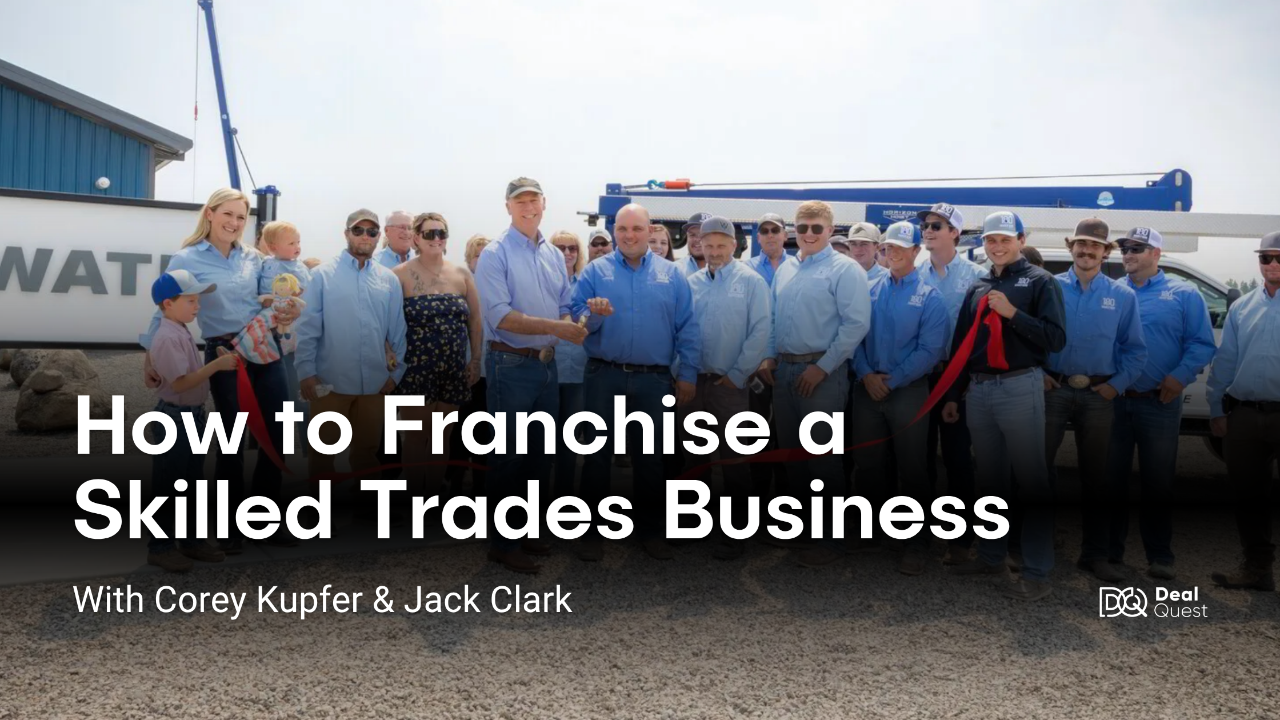
In this episode of the DealQuest Podcast, I'm genuinely excited to welcome Jack Clark, founder and owner of 180 Water Franchising — a rapidly growing home services franchise specializing in water well pump installation, maintenance, and water system solutions. Jack grew up on a farm in Choteau, Montana, dropped out of college sophomore year to buy his first drill rig, and went on to build something no one in his industry had ever attempted before: franchising the water well business.
Jack didn't come from a franchise background or a business school. He came from a hayfield. He put a hundred thousand miles on his pickup in a single summer running four drill rigs and thirty-five employees, hit a wall of exhaustion and inefficiency, and turned that breaking point into the spark for an entirely new model. 180 Water Franchising now operates in five states with ten franchisees, and Jack is building the systems, the trucks, and yes, even the manufacturing infrastructure to take it national.
Whether you're an entrepreneur who has been grinding in a single-owner service business and wondering if there's a smarter way to grow, someone considering buying a franchise in a field with real barriers to entry and recurring demand, or a business owner navigating the messy reality of investing ahead of your next level of growth — this conversation has a lot to offer. Jack talks openly about what scaling actually costs, what franchising actually is at the operational level, and why being the first person to do something in your industry is a competitive moat, not a warning sign.
THE WAKE-UP CALL THAT CHANGED EVERYTHING
Jack's path to franchising wasn't a strategic pivot planned on a whiteboard. It was a wake-up call. By his own account, he was running four drill rigs and thirty-five employees at peak, putting a hundred thousand miles on his truck in one summer, sleeping in his pickup between jobs, and spreading himself and his team thin across two locations. As he put it: "I sent my best guys the worst projects and my worst guys the best projects and nobody won."
That experience forced an honest question: was there a better way to serve customers who couldn't wait, in an industry where water is a necessity, not a luxury? His answer eventually led him to the franchise model — not because he had always admired franchising, but because the numbers finally made sense when he watched his office manager diagnose pump failures over the phone without ever seeing a well.
THE MOMENT THE MATH CLICKED
One of the sharpest moments in this conversation was Jack's description of how he actually committed to franchising. He had been considering it for the drilling side of the business, but the variables were too complex. Then one day he walked through the door and heard his relatively new office manager correctly diagnosing pump problems over the phone. That was it.
"If she can never see a well system and be able to diagnose it over the phone and she's correct, there's a pattern to this," he said. From that observation, he and his team started unfolding the layers of what was actually replicable across the country. The process became systematic. The offer became tangible. The math finally worked on the service and pump side, and the franchise model came into focus.
FIRST IN THE INDUSTRY — AND WHY THAT MATTERS
180 Water Franchising is the first franchise in the water well industry. Jack confirmed directly in our conversation: "No one's ever franchised the water well industry. I think a lot of guys have talked about it, but it's one of those things that until you really start to unfold it, you don't really realize how many layers there are to it."
Being first in an untapped space carries real advantages. There are no competing franchises. The industry is accustomed to the mom-and-pop model — usually a small owner-operator with five to ten employees — so the service quality and responsiveness that a franchise system brings is a distinct differentiator. On top of that, Jack noted that roughly half of the water well industry is looking at retirement in the next five years, driven by the fact that equipment is expensive, operators tend to enter the field later and stay longer, and the skilled labor pipeline is thin. That's a structural demand gap that 180 Water is positioned directly inside.
THE FRANCHISE STRUCTURE AND WHAT FRANCHISEES ARE BUYING
The standard investment for a 180 Water franchise is approximately $250,000, which covers a fully stocked service truck. Franchisees go through a two-week training program in Montana. The training isn't designed to make them master drillers overnight — it's designed to teach them the language of the industry so they can communicate, diagnose over the phone with support from headquarters, and execute confidently in the field.
The fee structure includes a 6% gross sales royalty back to the franchisor, a 2% brand fund, and a $45,000 franchise fee. Jack mentioned that for the first franchisee in each new state, 180 Water waives that $45,000 fee to share in the risk of opening a new territory. As he put it: "You're the first guy taking a chance, I'll take a chance on you, too." The goal is to invest together in proving out the market before collecting the full fee.
Suppliers are set up with 90-day terms, which softens early operating costs. The territories are intentionally sized to allow franchisees to eventually run two to three trucks with five or six employees — a scale Jack described as genuinely electric to watch once it gets going.
DEMAND THAT DOESN'T REQUIRE MUCH SELLING
One of the most notable aspects of this conversation was Jack's description of the demand environment. Franchisees are not cold-calling or running aggressive outbound campaigns hoping to build a pipeline. The business finds them. As Jack described it, most concerns about whether there will be enough work go away within the first thirty days. Some franchisees are busy before they even leave training.
Jack's top franchisee, Clayton, out of Billings, recently crossed a hundred Google reviews in a year and was already looking at adding a second truck and hiring an employee. That kind of traction, in a business with real barriers to entry and recurring service needs, is part of what makes the model attractive to the right operator. When people don't have water, they need service now. They're not comparing options or waiting for the best deal.
BUILDING THE TEAM THAT MATCHES THE NEXT LEVEL
Jack was candid about the unexpected challenge that comes with rapid growth: the team and the relationships that got you to a certain stage are not always the ones that can take you to the next one. He talked directly about closing the chapter with his original banker — someone who took a chance on him at twenty years old — and how even that conversation, handled with mutual respect, was bittersweet.
This connects to something I see constantly with entrepreneurs. What got you here truly will not get you there. That means upgrading your banking relationships, your internal team, your systems, and sometimes the external advisors around you. Jack called this out himself when he said building the franchise operation required "a whole new team that understands our next level of business." Those transitions are real costs, both financial and emotional. Entrepreneurs who scale are almost always the ones willing to make them.
We covered similar ground from a very different angle in our conversation with Cliff Nonnenmacher in Episode 329, where he walked through the franchise broker perspective and what separates strong franchise systems from weak ones. Jack's conversation is the operator's view of the same questions.
THE "STUPID RULE" POLICY
Jack brought up something I hadn't heard put quite this way before, and it stuck with me. He described having what he calls a "stupid rule policy" inside 180 Water. The principle is simple: if a rule has to exist, it means the underlying system needs to change. Good systems shouldn't require a list of bad rules to hold them together.
He was self-aware about this too. By his own admission, he probably would have been a terrible franchisee. He skips steps, goes from one to three to five in the instructions, and has no patience for unnecessary approvals. But that mindset, he argued, is exactly what makes 180 Water's franchise system work. Because he personally hates stupid rules, he refuses to build them in. The result is a franchisor that stays lean, responsive, and genuinely focused on making the franchisee's life easier.
HOW FRANCHISEES TEACH THE FRANCHISOR
One of the more counterintuitive things Jack shared was about the direction of learning inside a franchise system. He and his team meet every Thursday with all franchisees. Early on, those calls were mostly Jack sharing what he knew. Now, he said, it's the franchisees who've been running for two years who are teaching the new ones — and sometimes teaching Jack.
"Our newest franchisee teaches us more about the well industry than a guy with thirty years experience because he's looking at it through a different lens," he said. The collective data, tested across multiple markets simultaneously, accelerates the quality of the entire network. That's a specific advantage of scale that a solo owner-operator can't replicate. It's also a strong argument for why the right franchise model, built by people who genuinely care about franchisee outcomes, is a vehicle for knowledge that compounds over time.
Greg Mohr, who joined us in Episode 333, spoke extensively about what to look for from the franchisee's side of that equation — including how to evaluate whether a franchisor is truly invested in your success. Jack's model is a live illustration of what that investment looks like in practice.
MANUFACTURING THEIR OWN TRUCKS
Part of what makes this story interesting from a deals and growth perspective is that Jack didn't stop at franchising. When service trucks became unavailable through their Texas supplier, 180 Water started manufacturing their own — under the brand PumpEx Voice. That's a vertical integration move that not only solved a supply constraint but also opened up a new business line.
The franchise growth was creating real infrastructure needs, and rather than accept a bottleneck, Jack turned the problem into an asset. He mentioned that all current franchise locations, across all five states, are planning to open drilling operations as well — an expansion of the service offering that the new drill rigs and apprenticeship program will support.
FREEDOM, ON JACK'S TERMS
My final question on every DealQuest episode is about freedom. Jack's answer was specific and personal. Freedom, for him, means working only with people he wants to work with. He made himself a promise when he was running thirty-five employees and grinding non-stop: he would never again work with someone he didn't like. He said he has held true to that — and that it has been very freeing.
That's a simple statement that holds a lot of weight for anyone who has built a business and faced the recurring tension between what the business needs and what you actually want your daily life to look like.
Tune in to this full episode to hear Jack Clark break down how he built the first franchise in the water well industry, why the demand environment is unlike most service businesses, what the investment and structure looks like for franchisees, and how he is building 180 Water into a national operation without compromising the quality or culture that made it work in the first place.
- • •
Listen to the full episode of DealQuest Podcast Episode with Jack Clark: [Available on all major podcast platforms]
FOR MORE ON THIS EPISODE: [Episode URL]
FOR MORE ON JACK CLARK
Company: https://180waterfranchise.com
Company: https://180water.com
FOR MORE ON COREY KUPFER
https://www.linkedin.com/in/coreykupfer/
https://www.coreykupfer.com/
Corey Kupfer is an expert strategist, negotiator, and dealmaker. He has more than 35 years of professional deal-making and negotiating experience. Corey is a successful entrepreneur, attorney, consultant, author, and professional speaker. He is deeply passionate about deal-driven growth. He is also the creator and host of the DealQuest Podcast.
Get deal-ready with the DealQuest Podcast with Corey Kupfer, where like-minded entrepreneurs and business leaders converge, share insights and challenges, and success stories. Equip yourself with the tools, resources, and support necessary to navigate the complex yet rewarding world of dealmaking. Dive into the world of deal-driven growth today!

