
Reducing Lifetime Tax Drag for Business Owners with Omar Morillo
May 27, 2026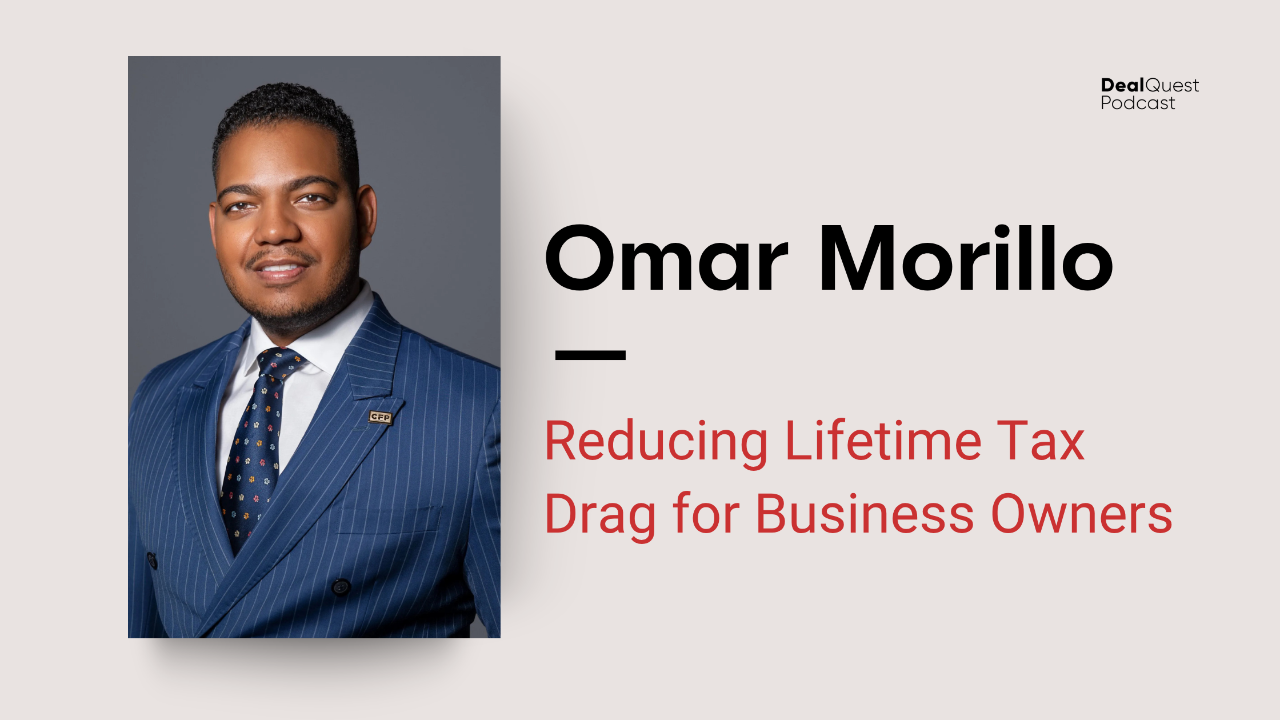
When Omar Morillo talks about wealth management for entrepreneurs, he frames it through one lens. Reducing lifetime income tax drag. Not just at the moment of exit, but across every layer of an owner's financial life. The income earned today. The portfolio working in the markets. The capital tied up in operations. And eventually, the liquidity event itself. Each one is an opportunity to position assets thoughtfully, and each one rewards owners who start years before the LOI hits the table.
I had Omar on the DealQuest Podcast because the entrepreneurs in our community spend years building businesses they hope to monetize one day, and very few have a clear handle on what tax planning actually looks like when you do this well. Omar is the founder of Imperio Wealth Advisors, a boutique firm focused on entrepreneurs, business owners, and families navigating liquidity, taxes, risk, and long-term decisions. He is a CFP, an accredited investment fiduciary, and a chartered financial consultant. Our conversation moved through pre-exit strategy, post-exit psychology, the flavor-of-the-month vehicles he sees pitched constantly, and why the cure is sometimes worse than the disease.
The Pilot Who Found Wealth Management
Omar opened with something a lot of people in this industry can relate to. He never planned to land here. As a kid, he wanted to fly airplanes. He wanted to be an airline pilot. The wealth management business is one of those careers, as he put it, that you fall into. That outsider entry point shows up in how he approaches the work today. He is not dogmatic. He is not married to one product or strategy. He treats every situation with what he called an agnostic lens.
His first deal was recent and personal. He met the founder of a global online education company at a business summit in Dubai, and the two of them hit it off. Omar believed online education was not just a COVID fad but a structural shift that could open access to learning across regions and populations. That conviction led him to invest. The way he tells the story reflects how he thinks about deals generally. Find people you connect with, identify a thesis you actually believe in, and act on it.
The Tax Lens Across Every Layer
Omar's approach is straightforward in concept and detailed in execution. He looks at four areas where tax exposure shows up. Current income. The investment portfolio. Working capital inside the business. And eventual liquidity events. Each one needs its own set of moves, and each one compounds when the strategy starts early.
For income tax reduction, he does not stop at the basics. The owners he works with are well past the point of an ordinary 401(k) or profit-sharing plan. He looks at pensions and cash balance plans. He coordinates with the client's other advisors to make sure entity positioning is optimized. He considers advanced deductions through 1031 exchanges, Delaware Statutory Trusts, and qualified opportunity zone funds. The portfolio itself becomes a tool for tax mitigation rather than just wealth accumulation.
Why Years Matter Before The LOI Arrives
The most important point Omar made about pre-exit planning sounds simple, and yet most entrepreneurs ignore it. The sooner you start, the more options you have. He said he would say it until he was blue in the face. You do not want to wait until there is a letter of intent on the table to begin estate planning, gifting shares, or restructuring a portfolio for capital loss generation. By that point, the company has independent evidence of value that limits flexibility.
He gave a concrete example. Imagine a business owner heading toward a $100 million exit who currently has $20 million in liquid assets. If those assets are positioned to generate carry-forward capital losses over several years, by the time the exit arrives the owner could potentially have a $40 to $50 million offset against the gain. As Omar put it, that $100 million exit could potentially be sliced in half. The compounding only happens with time, which is why the conversation needs to start years in advance.
The Three Levels Of Tax-Aware Investing
Omar walked through how he educates clients on long-short strategies, which have become a popular planning tool for owners facing significant capital gains. He framed it as three levels of sophistication.
Level one is the simple Warren Buffett approach. If you believe no money manager beats the S&P 500 over a decade, you buy an ETF like SPY or VOO and you let it ride. Level two is direct indexing. You unpack the basket and own each component stock individually. Throughout the year, you sell the underperformers to harvest losses inside the portfolio. The strategy generates what Omar called tax alpha, a better after-tax return achieved by capitalizing on the inefficiencies of individual index components.
Level three is long-short. The portfolio goes long on stocks that quantitative research favors and shorts the ones that look weakest. By design, this generates more losses, which build into a loss bank that can be deployed when the entrepreneur needs it most. Omar was careful to note this is for sophisticated investors with appropriate risk tolerance, ideally business owners or real estate investors anticipating significant capital gain events. I asked him about AQR specifically, because that is the name I keep hearing from clients and advisors, and he confirmed long-short has been democratized over the last few years for exactly these planning purposes. As he said, long-short is not new. The democratization is.
Estate Planning And The Miami Dolphins Lesson
Omar made the case that estate planning sits at the heart of pre-exit work. Gifting shares when they are valued lower can change outcomes for the next generation. Setting up the right trust structures matters. And there is a hard tax reality most owners would rather not think about. Estate taxes come due nine months after death. If the business is the bulk of the estate, the family may have to liquidate at the worst possible time to pay the bill.
He pointed to the previous owners of the Miami Dolphins as the cautionary tale. The family had to sell the team because they did not have liquidity to meet the tax obligations. Sometimes the answer is something as simple as an ILIT, an irrevocable life insurance trust holding a basic life insurance policy. There is no need to reinvent the wheel. The need is to actually do the planning.
The PPLI Caution And The Cure That Becomes The Disease
Omar spent meaningful time on private placement life insurance, because it has become one of the most-pitched vehicles to ultra-high-net-worth entrepreneurs. He walked through how it works. Traditional permanent life insurance puts the company in control of the cash value investments. PPLI lets you create that same wrapper privately, hire your own investment manager, and place managed assets inside it while getting similar tax treatment.
The caution he raised was about investor control rules. He has had conversations with people being told to put company shares directly into offshore PPLI structures with the promise of avoiding tax. His view was that this is rarely as simple as advisors make it sound. He recounted a recent confidential conversation where someone wanted to set up a PPLI to hold a fund they themselves owned and controlled. He told them flatly that the structure could run afoul of investor control rules, and when the IRS comes knocking with disallowed deductions, penalties, interest, and fines, the people who pitched the structure are nowhere to be found.
The principle behind his caution applies to every flavor-of-the-month vehicle. Captive insurance had its moment. QSBS keeps having its moment. Long-short is having its moment now. Each can make sense for the right person in the right situation. None of them work as a one-size-fits-all answer. As Omar put it, sometimes the cure is worse than the disease. He also raised a practical question that gets ignored too often. Can you actually maintain the formalities of these structures for the next ten or fifteen years? In his experience, ninety percent of the time the answer is no.
Donor Advised Funds And Charitable Planning
I shared with Omar that my wife and I have been doing more on the philanthropic side and have been talking to our advisors about when a DAF makes sense. Omar is a fan of donor advised funds for the right situations. In a high income year, a substantial donation to a donor advised fund can offset a meaningful slice of income tax exposure while preserving the optionality of deciding later where the money should go. The tax benefit is real, and the chance to direct funds toward impactful causes is its own reward.
The Small Violin Problem And Post-Exit Identity
The conversation took a turn I appreciated when Omar asked whether I see this in financial services. The tendency for an entrepreneur who walks away with $5 million, $30 million, or $100 million to still wonder, what if it all goes away? I told him I see it constantly. People who did not come from wealth and made it themselves. People who inherited it and grew up hearing everyone is out to get them. The relationship with money is rarely as healthy as the balance sheet suggests.
Omar made the connection between identity and the engine. While someone is running a business, they have a sense of identity, a sense of purpose, and a built-in safety net. If everything goes wrong tomorrow, they can rebuild because they have an engine that produces money. After the exit, that engine is gone. All that is left is the brokerage account. If the markets move the wrong way, the prospect of rebuilding from scratch later in life feels daunting.
I have talked about post-exit founder depression on the podcast before, including in my conversation with Dave Hersh, who shared sobering statistics about how many founders struggle for years after a successful exit. Omar's framing added another angle. Most retirement planning sells a vision of mai tais on a beach somewhere tropical, but as he pointed out, you can only do that for so long before your liver gives out. Purpose has to be built well in advance of the day the wire transfer hits.
What Owners Are Actually Worried About Right Now
When I asked Omar about trends, the answer was consistent. Tax exposure remains the dominant concern for most business owners. He is hearing some questions about fuel prices and the broader cost of living, and clients with private credit exposure are asking how the recent news cycle affects them. His firm leverages Mariner Wealth Advisors on some of this work, which means due diligence and manager selection are happening at a level that a smaller boutique could not replicate alone. For listeners interested in the broader RIA acquirer landscape, I previously did a series of episodes with the CEOs of several serial acquirers in the wealth management space, and Mariner's leadership was part of that series. I am also working on a new episode focused on some of the lesser-known platforms and buyers in the RIA space for owners considering a transaction.
Who Imperio Wealth Advisors Serves
Omar was clear about his ideal client. Business owners and entrepreneurs concerned about current income tax exposure, looking for tax efficiency on accumulated assets, with an exit somewhere on the horizon they want to optimize for. The typical engagement starts around $5 million in investable assets, which lets clients check the qualified purchaser box and unlock a wider range of solutions.
His own definition of freedom captured something I appreciated. Time with family. The ability to jump on a plane and explore the world with his kids. The ability to think beyond himself and give back. As a first-generation entrepreneur who did not come from wealth, he wants his children to see that the kind of life he is building is something they can build for themselves. That is the kind of clarity that tends to translate into good advice for clients.
For business owners thinking about an exit five or ten years out, this conversation is a useful reset. The tools matter. The timing matters more.
Tune in to this episode to hear Omar Morillo break down how to reduce lifetime tax drag across income, investments, and liquidity events for entrepreneurs preparing to sell.
Listen to the full episode of the DealQuest Podcast Episode with Omar Morillo: [Available on all major podcast platforms]
FOR MORE ON OMAR MORILLO
https://www.linkedin.com/in/omarmorillo/ https://www.imperiowealthadvisors.com
FOR MORE ON COREY KUPFER
https://www.linkedin.com/in/coreykupfer/ https://www.coreykupfer.com/
Corey Kupfer is an expert strategist, negotiator, and dealmaker. He has more than 35 years of professional deal-making and negotiating experience. Corey is a successful entrepreneur, attorney, consultant, author, and professional speaker. He is deeply passionate about deal-driven growth. He is also the creator and host of the DealQuest Podcast.
Get deal-ready with the DealQuest Podcast with Corey Kupfer, where like-minded entrepreneurs and business leaders converge, share insights and challenges, and success stories. Equip yourself with the tools, resources, and support necessary to navigate the complex yet rewarding world of dealmaking. Dive into the world of deal-driven growth today!

