
Launching The DealQuest Quarterly Roundtable With Brian Meegan And Sara Mostafa
Jul 15, 2026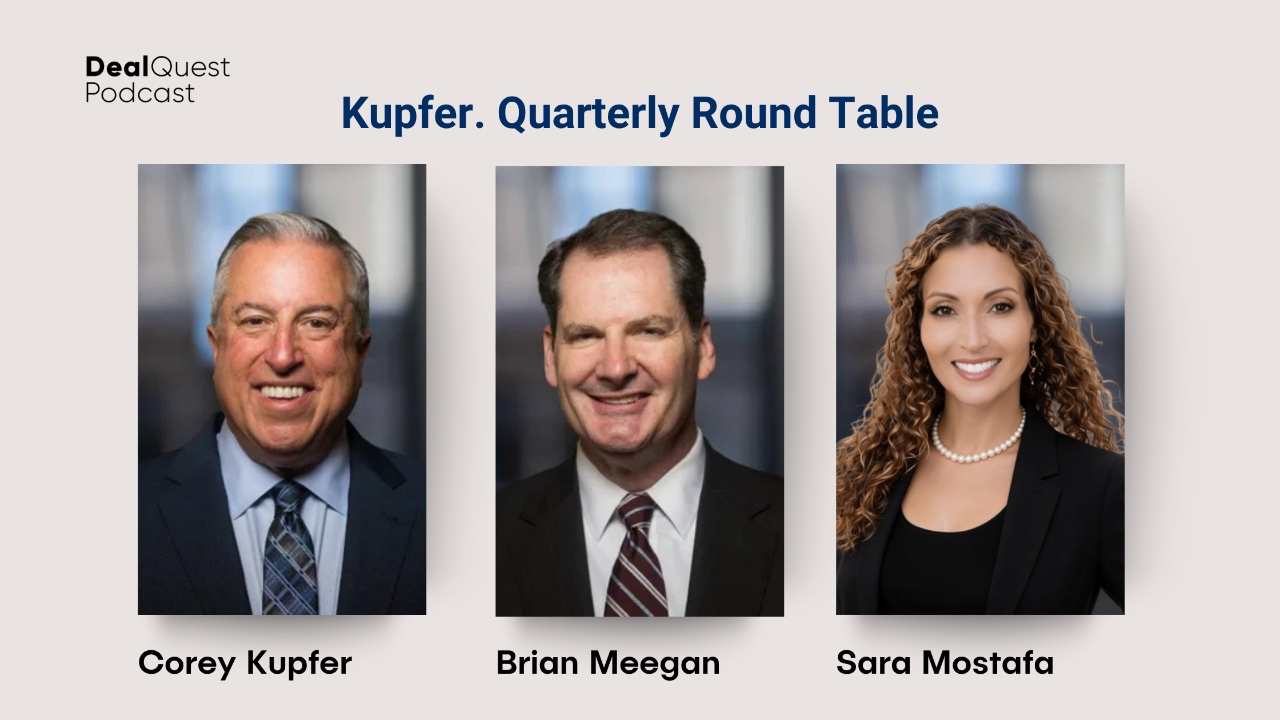
In this episode of the DealQuest Podcast, I'm thrilled to launch a brand new quarterly format with my law firm partners, Brian Meegan and Sara Mostafa. Between the three of us, we have roughly 90 years of combined deal experience, and we thought it would be valuable to come together each quarter, share what we're seeing across the deal market, talk about real transactions, and dive into negotiation lessons from history.
Brian Meegan has been a partner at our firm for several years, and Sara Mostafa joined us this year as our newest partner. Both bring deep transactional expertise across industries and geographies. Whether you're an entrepreneur navigating an acquisition, an RIA owner planning succession, or a business leader trying to read the current deal environment, this roundtable conversation gives you a real-time view into what experienced deal lawyers are seeing on the ground right now.
Launching The Quarterly Roundtable Format
After more than 400 episodes over eight years, I wanted to bring something different to the show. Our typical rhythm has been three guest interviews followed by a solocast. We're now adding a quarterly roundtable where Brian, Sara, and I come on together to talk about what's actually happening in deals, share war stories, and dive into a new Deals in History segment that Brian is bringing to the show.
The three of us collectively have around 90 years of deal experience. That kind of combined perspective is something I think our audience can benefit from on a regular cadence, especially as conditions across the deal market keep shifting.
What The 2026 Deal Market Actually Looks Like
Brian opened with an honest observation. Going into 2026, we projected a year of greater predictability and stability that would release a wave of pent-up M&A demand. The expectation was a banner year. That hasn't materialized. Energy price disruption, interest rate uncertainty, and a few other macro factors that nobody quite foresaw have kept the big bump in transactions from showing up.
That doesn't mean things are slow. Deal flow continues across our practice. The boom we anticipated just hasn't appeared the way we thought it would, and Brian noted that we may even see interest rates rise from here rather than continue the steady decline that was widely forecast. Beyond the volume question, both Brian and Sara are seeing a less frenetic pace toward closing. Quality of earnings work, due diligence, documentation, all of it is just moving with less urgency. As I noted in the conversation, that isn't necessarily a bad thing on the buy side, where rushing to close can compromise the quality of diligence.
The Wealth Management Exception And AI-Driven Small Deals
The wealth management space continues to defy the slower trend. Maturing industry dynamics, ongoing private equity capital, and succession needs are keeping deal flow robust in RIA transactions. That's been our biggest practice area for years and the volume reflects it.
Sara shared what she's seeing in smaller and mid-market deals outside wealth management. Valuations remain high, especially for targets that have successfully integrated AI into operations. Private equity interest and demand are very much present in that segment. On the buy side outside wealth management, the urgency to close has softened, but founders looking to exit quickly are still pushing for accelerated timelines when they're ready to move.
Why One Investor Is Building A Mini Berkshire In Virginia
I recorded an episode recently with Andrew Dunlap, who is taking an unusual approach to acquisitions. His fund focuses exclusively on Virginia-based businesses with longer-term holds, modeled loosely on a mini Berkshire Hathaway. The data point that stuck with me was one Andrew shared during our conversation. In Virginia, 82 percent of acquisition buyers were from out of state.
Even in a remote-work era, where headquarters sits still matters. When an out-of-state buyer acquires a company, top leadership talent tends to follow the new HQ out of state too. Andrew's commitment is to keep businesses local, retain leadership talent in second-tier and smaller cities, and build a portfolio that supports a specific geography. That kind of regionally focused, longer-hold strategy is a useful counterweight to the speed-and-scale narrative that dominates most M&A coverage.
The SpaceX IPO And The $60 Billion AnySphere Acquisition
Brian flagged space industry multiples as another area running hot, with comparisons to AI valuations. Lockheed Martin's footprint in Colorado has helped seed a robust space ecosystem there, and similar activity is happening in California. The SpaceX IPO and the subsequent activity around it brought the space-AI overlap into focus.
We also talked about the $60 billion all-stock transaction involving AnySphere, the startup behind the popular AI coding agent Cursor. When companies go public, that equity currency becomes a powerful tool for further M&A activity, and you saw it playing out almost immediately. Sara pointed out that Google's recent purchase of an AI film company runs counter to its own stated positioning on AI, which suggests that nearly every major player is now reshaping its portfolio around AI capabilities, whether or not that fits their original narrative.
Deals In History And The Korean War Armistice Negotiations
Brian introduced a new segment called Deals in History, drawing on his combined interest in both deals and history. His first selection was the Korean War armistice negotiations of 1951, which contained nearly every negotiation tactic anyone has ever written about.
The North Korean side picked up the UN delegation in cars carrying white flags, implying surrender. They used higher chairs to gain physical advantage. The shape of the negotiating table became a multi-meeting standoff. The Chinese wanted a round table for symbolic equality with the Americans. The Americans pushed for a rectangular setup with clear heads of the table. Eventually they settled on separate tables with documents in the middle, with both sides entering at the same moment. The size of the flags had to be measured and equalized because both sides kept trying to make theirs larger.
There was apparently a two-hour period where both sides sat in complete silence, scowling at each other, refusing to budge on a single boundary point. The full negotiation spanned roughly 160 meetings over two and a half years. The armistice that resulted is technically still not a peace treaty. It is a ceasefire that has held since the end of the war.
Walking The Abraham Path With William Ury
Brian's story reminded me of my own time spent with William Ury, the international peace negotiator who co-founded the Harvard Project on Negotiating and co-authored Getting to Yes. In 2017, my wife and I walked a section of the Abraham Path with William, a thirty-five mile network of trails in the Middle East mapped by an NGO he helped form. The path is built around where Abraham, the figure shared across Christianity, Judaism, and Islam, was said to have walked, and the tradition Brian summarized perfectly as radical hospitality.
William has worked with Chávez in Venezuela and likely others he can't talk about for decades. What struck me about him is that he doesn't tell war stories. If you ask him a question, he'll answer, but you only learn what he was actually involved in years after the fact. The number of stakeholders and the stakes involved in international peace negotiations dwarf even the most complex M&A transactions, and spending a week walking with William gave me a deep appreciation for what real cross-cultural negotiation requires.
A Cultural Lesson From A Post-Soviet Russian Deal
In the early 1990s, I was about eight or nine years into practice and got pulled into one of the first US-Russian commercial deals after the Soviet Union fell. My client sourced goods. A Russian group came in with a tanker ship, half filled with Purdue chicken (which we had nothing to do with) and the other half intended for blue jeans, cigarettes, and electronics. Standard practice on a deal like this is a non-circumvention agreement. The middleman makes the introductions and protects himself from being cut out of future direct deals with the suppliers.
The Russians refused to sign it. Not as a negotiating tactic, but as a deeply held belief. They had just come out from under communism, and being told who they could and could not do business with felt like the opposite of the freedom they had finally earned.
I told my client we were not going to win that point against the Russians, and our ability to enforce non-circumvention against them would be slim anyway. So we negotiated non-circumvention agreements directly with the US suppliers we were introducing, locked those up behind the scenes, and gave up the provision with the Russians in exchange for other concessions. The deal closed, the supplier protection held, and the lesson stayed with me. What looks illogical from one side may be a core belief on the other. Respect it and find another structural path to protect your client.
Cross-Border Capital From The Middle East, India, And China
Brian returned recently from travel in the Middle East and India and reported significant appetite for US investment from both regions. We're actively working on a deal right now bringing investment from one of those markets into a US business platform built through a roll-up strategy.
He also shared what came out of a meeting in Vancouver with Chinese contacts. For the first time since China emerged as a major economic player, Chinese investors are looking outward toward US opportunities. The flow of capital is shifting direction. There are real regulatory hurdles, but the intent and the actual movement of dollars are showing up.
Sara has been working on a different cross-border angle. She has clients in the plant nutrient industry with operations in Mexico and Costa Rica. The deals involve coordinating between American operating companies and offshore operations, plus structuring retention for top international talent. Those conversations get into whether to issue equity or phantom equity, how vesting triggers work, and what forfeiture conditions to apply. It's a reminder that cross-border deals are rarely just about the headline transaction. The personnel and equity structures often determine whether the combined operation actually works.
This conversation echoes what we explored with Sunny Vanderbeck back in Episode 293 about structuring deals so that they serve people and culture, not just numbers on a spreadsheet. The mechanics matter, and they only work when they fit the human reality on both sides.
Parting Wisdom From All Three Partners
We closed the episode with a new Parting Shots segment where each of us shared one piece of wisdom.
Sara spoke to women-owned and minority-owned business owners facing deficiencies in capital access. Her advice was to seek community, look for the specialized funds that exist for women-owned, minority-owned, and regionally focused businesses, and use those networks as resources for starting and growing. The capital is out there. The community is out there. You just have to look for it actively rather than assume the door is closed.
Brian opened with a Jim Collins line from 2009. Never waste a good recession. When markets soften, that's the moment to upskill, to hire the people you couldn't get during a tight labor market, and to invest with an eye toward the future. He also flagged the rising attention on AI token costs. As AI providers stop subsidizing usage and the real cost of inference surfaces, the economics of how and where AI is used will shift again. Pay attention to that as you plan AI-related investments.
My own parting wisdom is something I say often. There is a deal for that. Any business frustration, challenge, or opportunity has a possible deal structure that could address it. If you can't hire fast enough, maybe an acquihire works. If you want to expand geographically, an acquisition, joint venture, strategic alliance, or white labeling deal might solve it. You don't need to understand what the deal looks like. You just need to identify the frustration or opportunity, then come talk to someone who knows how to structure something that fits. That's a big part of what we do at our firm every day.
WANT TO BE A GUEST ON DEALQUEST?
Apply here: https://beaguestondealquest.com
Listen to the full episode of DealQuest Podcast with Brian Meegan and Sara Mostafa. Available on all major podcast platforms.
Corey Kupfer is an expert strategist, negotiator, and dealmaker. He has more than 35 years of professional deal-making and negotiating experience. Corey is a successful entrepreneur, attorney, consultant, author, and professional speaker. He is deeply passionate about deal-driven growth. He is also the creator and host of the DealQuest Podcast.
Get deal-ready with the DealQuest Podcast with Corey Kupfer, where like-minded entrepreneurs and business leaders converge, share insights and challenges, and success stories. Equip yourself with the tools, resources, and support necessary to navigate the complex yet rewarding world of dealmaking. Dive into the world of deal-driven growth today!

